Our Family's Journey Through Time
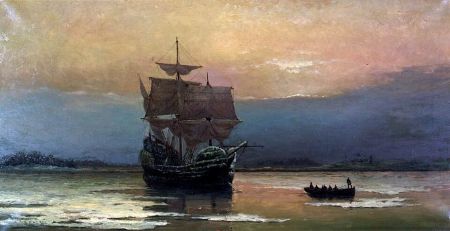
Image: Mayflower in Plymouth Harbor by William Halsall 1882
George Soule, our earliest known ancestor to arrive to the New World, sailed to Plymouth Colony aboard the famous ship Mayflower in 1620. He was one of 102 passengers who were on board when the Mayflower left Plymouth, England. The passengers, who became known as “Pilgrims,” held a mix of religious beliefs. Some were separatists who had left the Church of England. Others, who wanted to reform and purify the Church of England, had varying degrees of reformed puritan inclinations.
The original plan was that two ships would carry passengers and provisions, the Speedwell and the Mayflower. The Speedwell carried most of the members of the Leiden congregation, a large group of English Protestants living in exile in Leiden, Holland. The Speedwell sailed to Southampton where it met the Mayflower and its collection of English passengers.
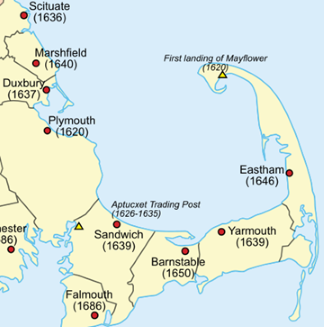 The two ships departed Southampton, but had to divert to Plymouth to make repairs on the Speedwell. When the Speedwell was then abandoned, the Mayflower took on as many passengers as it could hold, leaving behind several families, some of whom returned to Leiden, and some who eventually migrated to Plymouth. It is estimated that about two-thirds of the Mayflower passengers had been members of the Leiden congregation, and one third were gathered in England.
The Mayflower departed Plymouth, England 6 September 1620, and dropped anchor near the tip of Cape Cod, Massachusetts November 21, 1620 (current Georgian calendar dates).
Researchers much more advanced than I have still not determined George Soule's origins--where and when he was born and who his parents were. He is likely to have been born either in England or in Holland. What is known is that he was one of the passengers to board the Mayflower in Leiden, Holland, and that he was a servant of passenger Edward Winslow and his family. Once in Plymouth, his occupation was listed as Planter and Husbandman.
By 1633, George was listed as a freeman. He was active in the community, serving the Plymouth Colony General Court. He also served on the grand and pettit juries, and on the Committee on magistrates and deputies. In 1637 he volunteered for the Pequot War. He and his family were involved in several land sales and purchases.
Land along the coast was allotted to settlers for farming, and as the land was parceled out, many settlers began moving away from Plymouth. In 1637, George Soule was granted a garden place "on Ducksborrow side," where the community established became known as Duxbury. He continue to buy and sell land until his death (between 20 September 1677 (codicil to will) and 22 January 1679 (date of inventory).
George Soule's lengthy inventory proved that he had done well in the new country. He bequeathed generous plots of land to his sons and daughters. Among the items listed on his inventory were books, valued at £1, indicating that he was well educated. His children are listed at George Soule and Mary Buckett Family.
The New England Historic and Genealogical Society, aka NEHGS, (now rebranded as AmericanAncestors.org), provides a multitude of publications, webinars, and databases focused on what they have called The Great Migration (not to be confused with other "Great Migrations"). The goal of their Great Migration Study Project has been to "compile comprehensive genealogical and biographical accounts of the twenty thousand English men, women, and children who settled in New England between 1620 and 1640." Robert Charles Anderson was Director of the Great Migration Study Project for more than 36 years. Genealogists and historians alike describe Robert Charles Anderson as a “master scholar” and “the foremost authority on early immigrants to New England.” As Pulitzer Prize-winning historian David Hackett Fischer once said, Bob’s work is “one of the great historical projects of our time.” I have used and am still exploring many of the NEHGS resources. Here are a few of the most reliable sources especially regarding George Soule and the Mayflower:
Richard Charles Anderson, Mayflower Migration: Immigrants to Plymouth, 1620 (Boston: New England Historical and Genealogical Society, 2020).
Richard Charles Anderson, Pilgrim Migration: Immigrants to Plymouth Colony 1620-1633 (Boston: New England Historical and Genealogical Society, 2004).
Louise Walsh Throop, George Soule of the Mayflower and his Descendants for Four Generations, 7th edition (Plymouth MA: General Society of Mayflower Descendents, 2015).
The General Society of Mayflower Descendants.
Soule Kindred in America.
Caleb Johnson's Mayflower History.
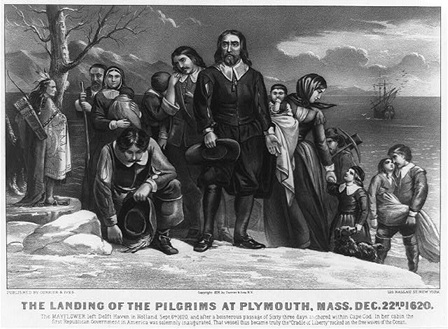
Image: Currier & Ives. The landing of the Pilgrims at Plymouth, Mass. Dec. 22nd
Plymouth Massachusetts, ca. 1876. New York: Published by Currier & Ives, 125 Nassau St.
Library of Congress Photograph.
We strive to document all of our sources in this family tree. If you have something to add, please let us know.